Venezia is unique. It's not simply a city with canals, but a fully realized urban system built on water. Instead of expanding over land, it grew across a lagoon on a dense network of wooden piles driven into mud, supporting stone and brick structures that behave like a continuous architectural fabric. Streets are often replaced by canals, and the usual hierarchy of roads gives way to a fluid circulation system where boats function as public and private transport. Buildings rise directly from the water with minimal separation between infrastructure and architecture, creating a seamless interplay between engineering and aesthetics. The result is a city where urban planning, structural necessity, and visual identity are inseparable, producing a landscape that has no true parallel elsewhere.
I rented an apartment in the San Polo district, in an area called Campo San Boldo. There used to be an 11th-century church here, dedicated to Saint Agatha. It was rebuilt multiple times, and from the 15th century onward it became associated with Saint Ubaldo, which eventually gave the area its current name ("San Boldo" is a Venetian distortion of "Sant'Ubaldo"). Later, the church was demolished and replaced with a residential building, but the bell tower is still there. You may recognize the area from the movie A Haunting in Venice. Although the film set was built in a studio, the exterior of the palace was based on Campo San Boldo, and they shot a few scenes with Poirot and the other guests just a few steps from my front door.
The house from A Haunting in Venice
For most of the month, I just wandered around the city, letting myself get lost in the labyrinth of alleys and canals, pretending I could absorb a flicker of brilliancy from Venezia's prominent sons, like Vivaldi or Canaletto or Casanova, or even from the famous foreigners who lived here, like Byron or Wagner or Hemingway.
But I also visited the expected museums and historical places to see some very interesting art and architecture.
Close to my apartment, there is the Museo di Palazzo Mocenigo, which is less crowded by tourists than other, more famous locations. As the name says, it used to be one of the residences of the Mocenigos, a family that saw seven of its members become doges (the doge was the highest authority in the Republic of Venice). Today, it's a museum dedicated to textiles, costume, and perfume.
Palazzo Mocenigo
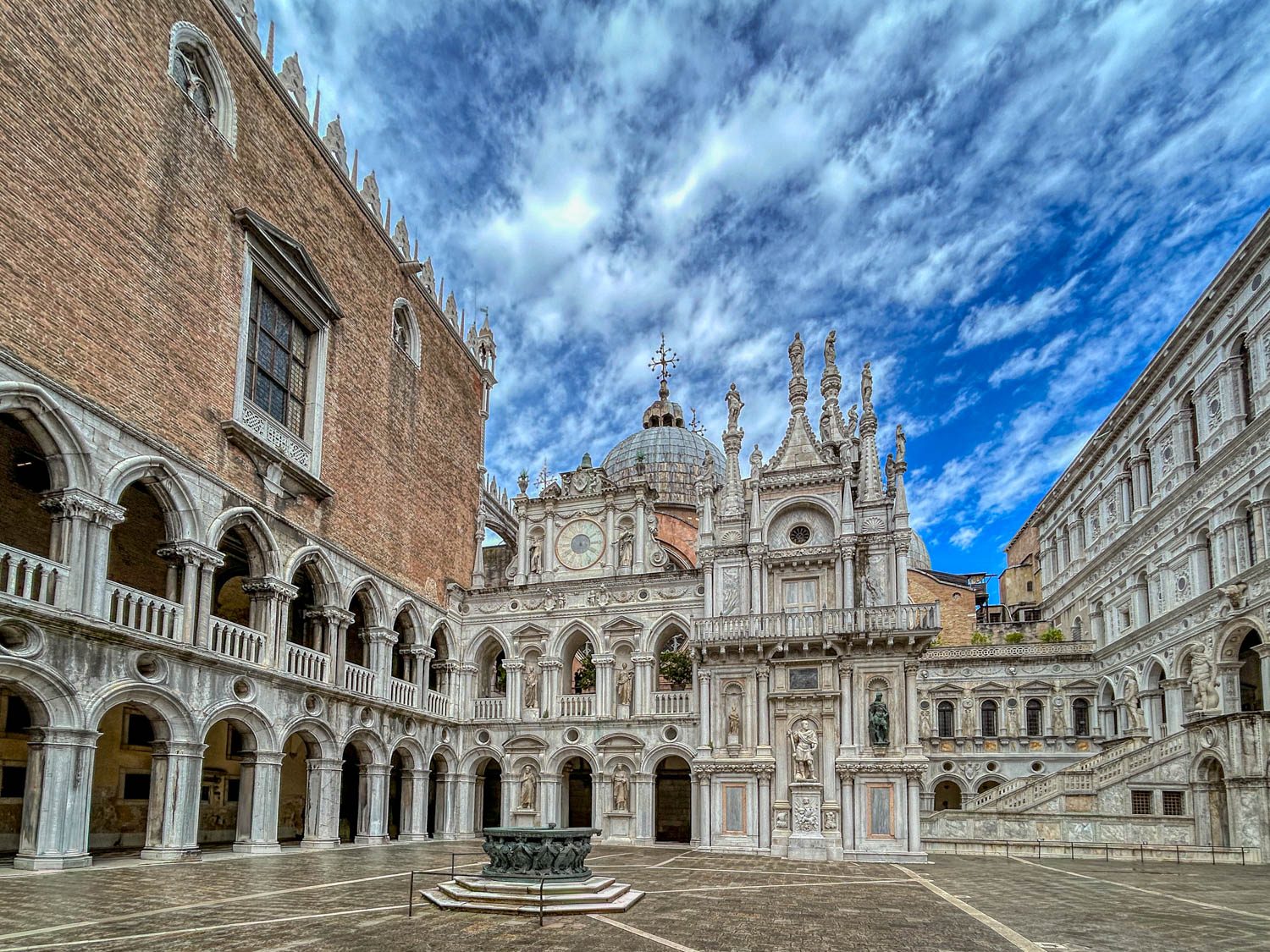
The renowned Palazzo Ducale, in the Piazza San Marco, has an impressive picture gallery, including masters like Titian, Tiepolo, Bellini (yes, also the name of a cocktail), Carpaccio (yes, also the name of a dish), among others. They have a curious painting attributed to a follower of Hieronymus Bosch, Apocalyptic Vision, that looks very much like a work by Bosch himself. But the palace itself is even more interesting than the art it contains. It was built between 1483 and 1565, and displays a mix of Gothic, Renaissance, and Mannerist elements. The courtyard, the Doge's Apartments, the armory, the prisons (to get there, you go through the famous Ponte dei Sospiri, or Bridge of Sighs), it's all fascinating.
Palazzo Ducale, courtyard
Across the Piazza San Marco, there's the Museo Correr, which also contains the Museo Archeologico Nazionale and the Biblioteca Marciana. Lots of historical objects, statues, and paintings (including quite a few by Bellini and Carpaccio, and even one by Pieter Brueghel the Younger). I really liked the collection of Roman statues, both of emperors and mythological figures.
Piazza San Marco
Also in the Piazza San Marco, there was an interesting exhibition at the Istituzione Fondazione Bevilacqua la Masa, Picasso, Morandi, Parmiggiani: Still Lifes. Parmiggiani felt very out of place there, even outclassed, but seeing Picasso and Morandi together was intriguing: one breaks the objects apart, the other reduces the objects to a quiet essence.
Goat Skull, Bottle, and Candle (1952), by Pablo PicassoStill Life (1963), by Giorgio Morandi
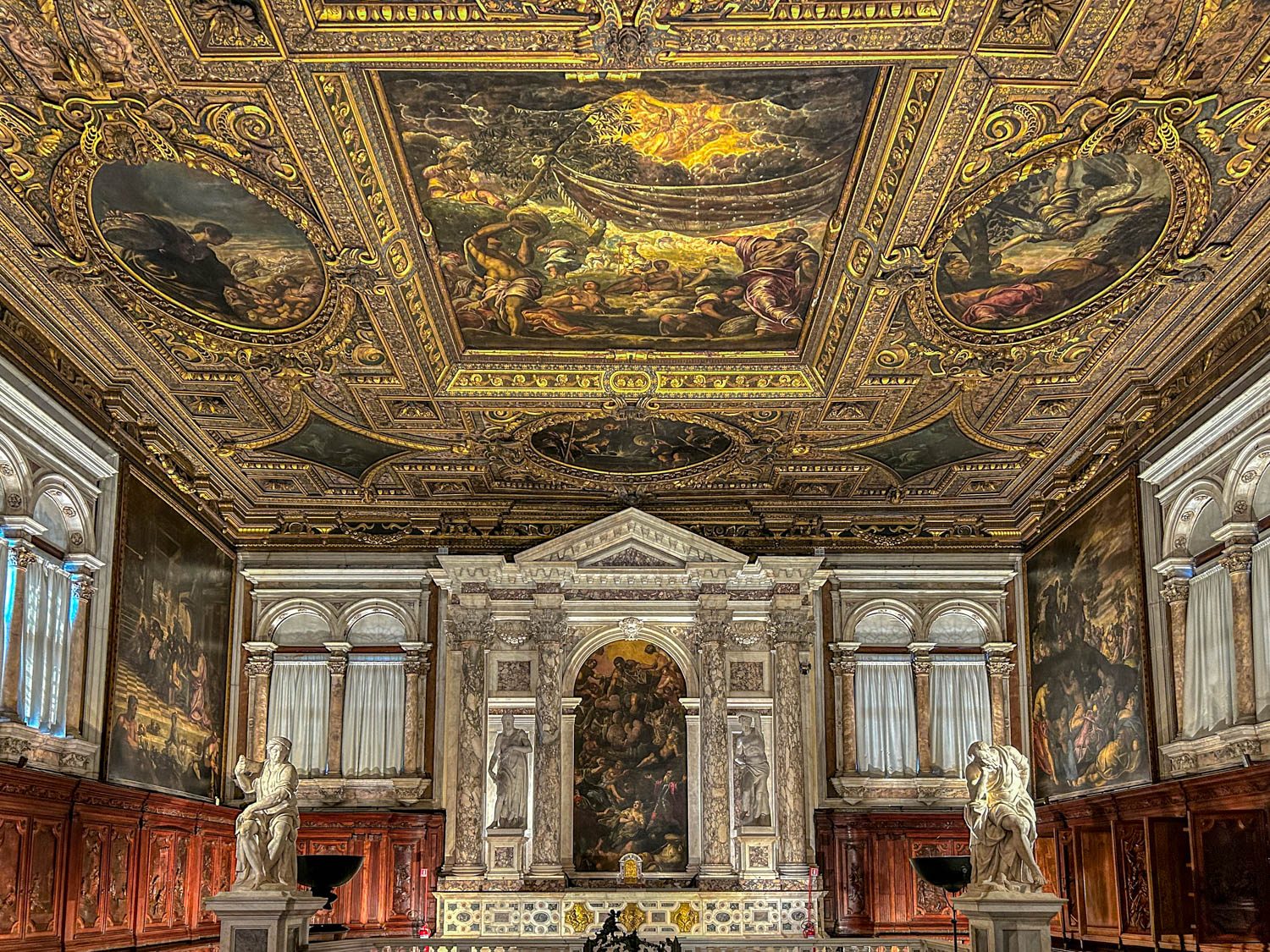
At the Scuola Grande di San Rocco, I saw some monumental paintings by Tintoretto. Built from 1515 to 1560, right next to the Chiesa di San Rocco (Church of Saint Roch), it was some sort of clubhouse for rich Venetians. They hired Tintoretto to decorate the place, and most of the art on the two large halls (one on each floor) was made by him and his team. It's really impressive, almost on the same level as the Cappella Sistina in the Vatican. There are also some paintings by Giorgione, Titian, and Tiepolo.
Scuola Grande di San RoccoScuola Grande di San Rocco and Chiesa di San Rocco
Another similar (but much smaller) institution I visited was the Scuola Grande di San Giovanni Evangelista. It has frescos by Tiepolo, one painting by Tintoretto, and a few by Carpaccio and Bellini, all with the theme of the crucifixion (because they claimed to have a piece of the wooden cross on which Jesus was crucified).
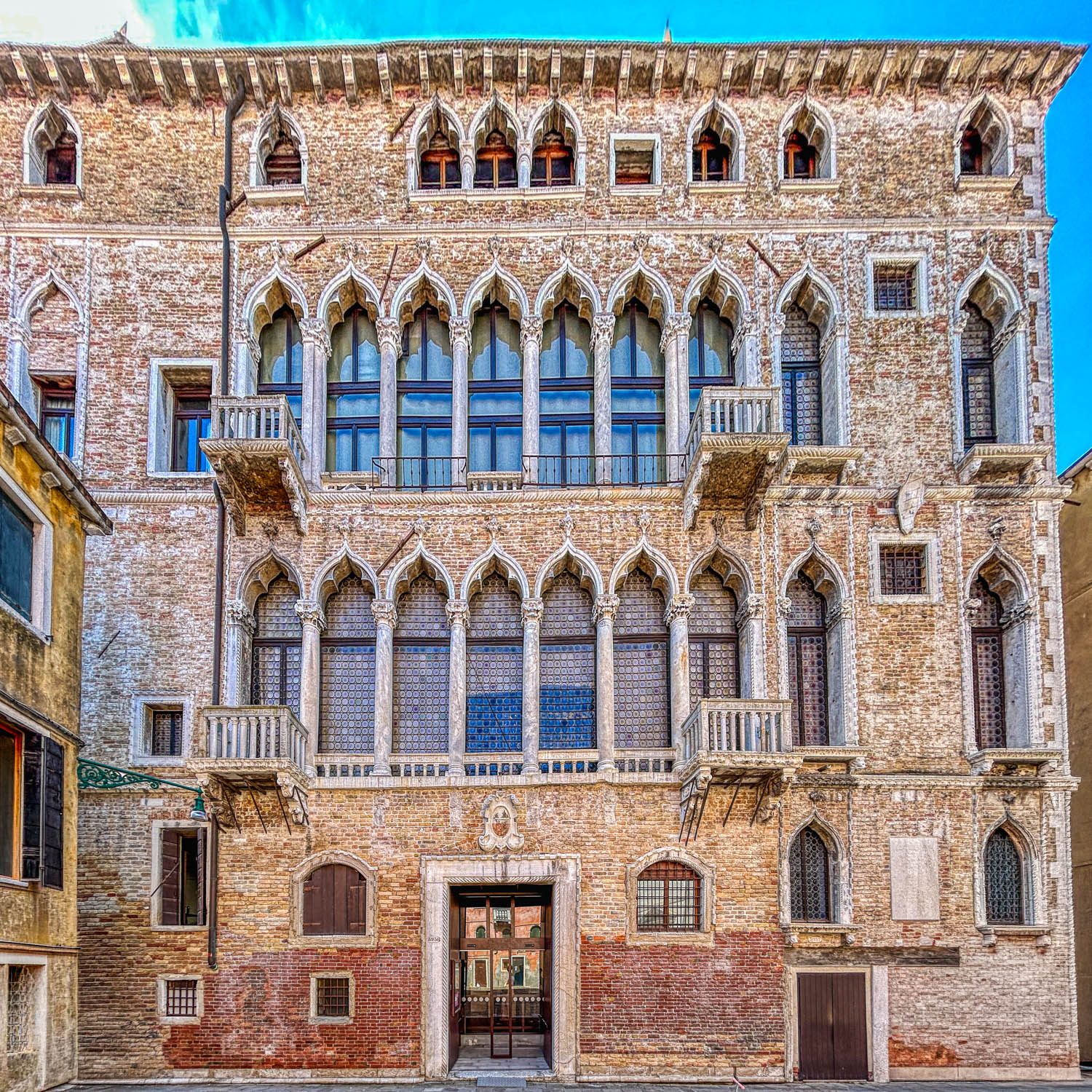
The Museo Fortuny is housed in the Palazzo Pesaro Orfei, where Mariano Fortuny y Madrazo (1871–1949) lived and worked. He was Spanish, but his family moved to Paris and then to Venezia. The man did everything: painting, sculpture, engraving, photography, textiles, fashion, theatre decor and light, and even patented several inventions. Impressive.
Palazzo Pesaro Orfei
The Gallerie dell'Accademia is a museum full of monumental Renaissance paintings. Tintoretto, Veronese, Titian, Carpaccio, Bellini, the usual suspects. They also have three works by Hieronymus Bosch: The Hermit Saints triptych, The Crucifixion of Saint Wilgefortis triptych, and the polyptych Visions of the Hereafter (which contains Fall of the Damned, Hell, Terrestrial Paradise, Ascent of the Blessed).
Visions of the Hereafter (c. 1515), by Hieronymus Bosch
Not far from there, the Collezione Peggy Guggenheim has an outstanding selection of 20th-century art: Picasso, Magritte, Dalí, Ernst, Miró, de Chirico, Pollock, Klee, Malevich, Lissitzky, Calder, Moore, Noguchi, Giacometti, and many others. The building is lovely too, the 18th-century Palazzo Venier dei Leoni, with a sculpture garden and a view of the Grand Canal.
Peggy Guggenheim Collection
One day, I went on a little Tintoretto walk. First, I visited his house and studio (you can only see the façade, it's not a museum), in the Cannaregio district, a quieter area north of the usual tourist flow. Then I went to the Chiesa della Madonna dell'Orto, which was Tintoretto's parish church and effectively his artistic sanctuary. Several of his major paintings are still there, and he is buried inside the church. His real name, by the way, was Jacopo Robusti. He was nicknamed Tintoretto because his father was a dyer (tintore, in Italian), so he was the dyer's boy (tintoretto).
Tintoretto's house
Another dead Venetian that I visited was Marco Polo (he wasn't home). I find it very unlikely that an European guy goes to China and then fails to mention that they write using those characters or that they eat with chopsticks. Instead, he talks about encountering dog-headed men and a gigantic bird capable of seizing an elephant in its talons. So I'm skeptical about the whole story. Perhaps Rustichello of Pisa, his ghost writer, is the man to be blamed for those exaggerations. Who knows? Anyway, I saw the place Venetians claim to be the place where he lived, the Corte del Milion. But nobody seems to know even which house it was. There used to be a plaque above a restaurant saying that it was the house, and now you can't see it because there's a screen in front of it as the restaurant is apparently being renovated. While I was there, a tour guide brought a group of tourists and pointed to the house on the left, claiming it was the one. Then, a few minutes later, another group came in, and their guide pointed to the house on the right side. It was almost like a story told by Marco Polo himself.
Marco Polo's house (or perhaps not)
Finding the house where Byron lived here in Venezia wasn't so easy. All we know is that he rented the second floor of Palazzo Mocenigo on the Grand Canal, but that's not just one building, it's several buildings grouped together. It's assumed he was in the central section of the complex, with his fourteen servants, two monkeys, one fox, and several mastiff dogs.
Another writer's house that I visited was Carlo Goldoni's, which is now a museum. Goldoni, of course, was a famous and prolific playwright, author of tragedies, comedies, and opera librettos. The museum was very small, only three rooms, but the staircase leading to it was very stylish.
Goldoni's house
At the Basilica Santa Maria Gloriosa dei Frari, I saw the pyramidal tomb of Antonio Canova (much larger than Nicolas Cage's pyramid in the New Orleans cemetery). But it's not really his tomb, because his body is actually buried in Possagno, his hometown. However, in a bizarre turn of events, they took his heart out and put it in this Venetian tomb. Not only that, they cut his right hand off and preserved it in a vase at the Accademia di Belle Arti, here in Venezia. That's how they treated their celebrities.
Canova's pyramid
I also visited the small Santa Maria della Pietà, called by many "the Vivaldi church". But he was already dead when they started building that church, and obviously never played there. The concerts he conducted happened in a previous church, roughly on the same site, attached to the old orphanage-hospital complex. The tourists don't know that, though, or don't care, and flock to the place to listen to Le Quattro Stagioni. I did go to one of those concerts more than thirty years ago, when I visited the city for the first time, with my parents.
Santa Maria della Pietà
My limited budget didn't allow me to pay two hundred and fifty euros to watch the opera Carmen at the Teatro La Fenice (The Phoenix Theatre), but I visited the building during the day. It's one of the most famous places in the history of opera, having premiered works by Rossini, Bellini, Donizetti, and Verdi. It was built in 1755, then burned down in 1836, and then burned down again in 1996. But, true to its name, it was rebuilt once more and reopened in 2003, preserving a 19th-century style. Coincidentally, one of the books in my Venezia reading list was Death at La Fenice, by Donna Leon, the first in the Commissario Guido Brunetti series, about a murder during the production of La Traviata at La Fenice.
La Fenice
I also couldn't miss the Palazzo Contarini del Bovolo and its almost Escherian external spiral staircase. It's very beautiful. You've seen it if you watched the 1952 adaptation of Othello, by Orson Welles. And Othello was, don't forget, "The Moor of Venice".
Palazzo Contarini del Bovolo
And the food? And the side trips?
As you may have noticed, this newsletter is already very long. So let's leave the food and the side trips for the next one. I'll send it in a couple of days.