Venetian Harbor, with the Koules Fortress in the back
Crete was the land of the Minoan civilization in the Bronze Age (that was more than five thousand years ago). Then the Mycenaeans came from mainland Greece and took over. After them, the Roman Empire, the Byzantine Empire, the Venetian Republic, and the Ottoman Empire (even the Andalusian Arabs took control for a little while). Crete became independent in 1898, and joined Greece in 1913. All these cultures left a mark, and are reflected in what you can see around the island.
Then there's the mythology. Remember the story of Theseus fighting the Minotaur inside his labyrinth? That was here in Crete. What about Daedalus and Icarus escaping prison using wings made of feathers and wax? Also here in Crete. And Talos, the massive man of bronze who protected the island from pirates (you saw him in Jason and the Argonauts), that was in Crete too. Not enough? You know where Zeus was born? Crete, of course.
Breakfast on my little balcony
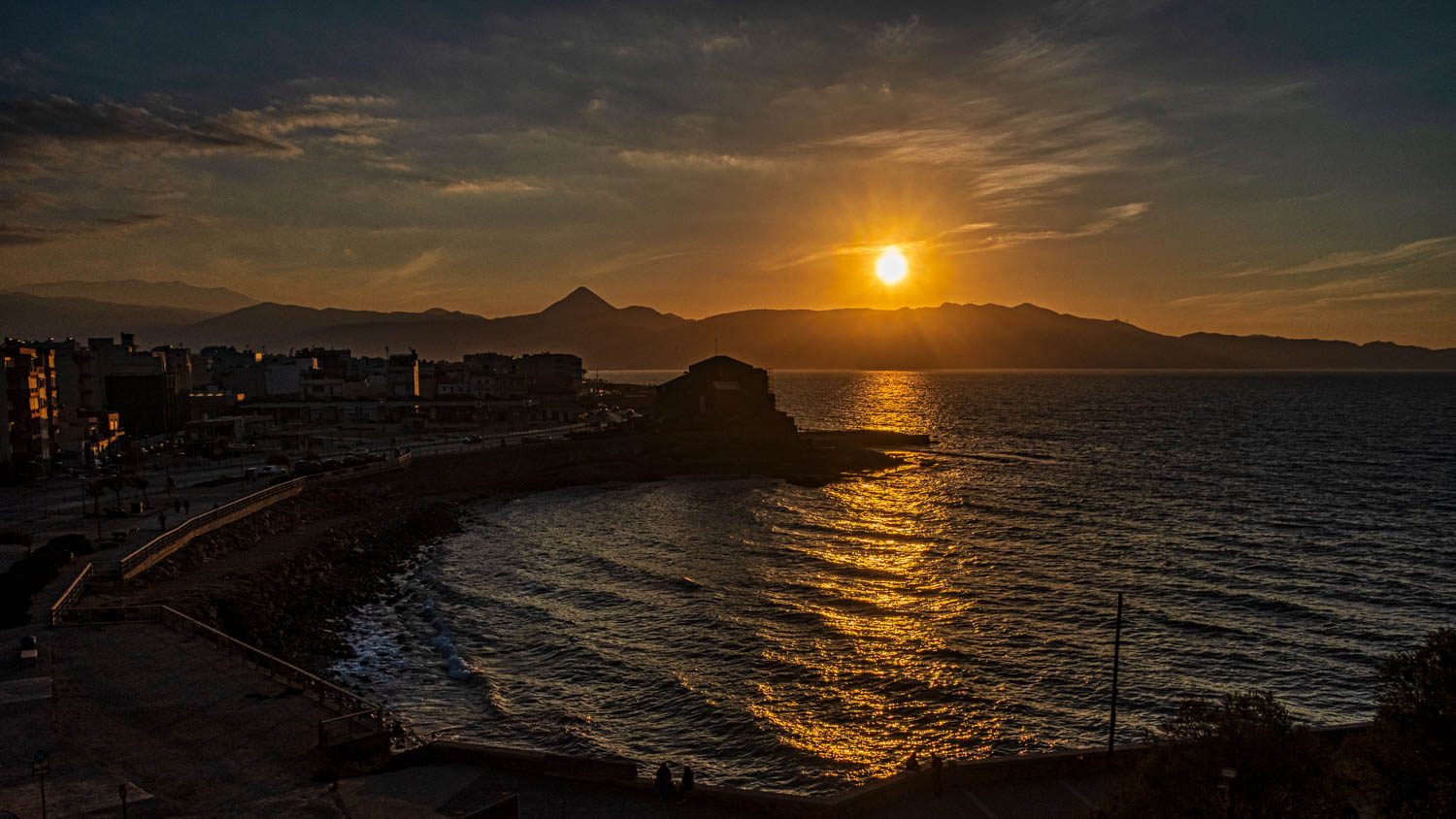
I rented a small apartment in Heraklion (in Greek, Iráklio), capital of Crete (in Greek, Kríti). It has a relaxing view of the Sea of Crete, which is part of the Aegean Sea, which is part of the Mediterranean Sea. Just a few steps from my door is the Koules Fortress, also called Castello a Mare ("Fort on the Sea", in Italian). It's a 16th-century fortification built by the Republic of Venice to defend the port. From there, a long wall extends into the sea, serving both as a breakwater and as a promenade (it's a 5 km walk to go all the way to the end and back to the fortress).
There is more old Venetian architecture around town, including the Venetian Loggia, the Morosini Fountain, and the Venetian Walls.
A couple of very famous artists were born in Crete. Doménikos Theotokópoulos (1541-1614) left the island to live in Italy and then in Spain, where he became known as El Greco and celebrated as one of the best painters of all time. A few blocks from my apartment, there's a little park named after him, with his bust at the center. The Historical Museum of Crete, also close to my apartment, has two of his early paintings. Nikos Kazantzakis (1883-1957) is the most acclaimed modern writer in Greek history, author of Zorba the Greek (which I've been reading while here) and The Last Temptation of Christ, among others. The Historical Museum of Crete displays his study and library, transferred from his home in Antibes, France. I saw his grave, atop the Venetian Walls, marked with the epitaph "I hope for nothing. I fear nothing. I am free."
Another interesting little museum near my apartment is the Museum of Ancient Greek Technology. It displays working replicas of fascinating machines from many centuries ago, including hydraulic clocks, astronomical instruments, a pantograph, several automata, musical instruments, and more. One of the stars of the show is a model of the Antikythera mechanism (a few years ago, I saw the original fragments at the National Archaeological Museum in Athens). It's considered the oldest known analog computer, possibly dating back to the 2nd or 3rd century BCE, used to predict astronomical events such as eclipses. They also have a water organ from the 3rd century BCE, the world's first keyboard instrument.
Water organ
But the great museum in Crete is the Heraklion Archaeological Museum, which contains a treasure of Minoan art, most of it extracted from the Palace of Minos in Knossos (more about that later). Many objects that we always see in art history books are there, like the so-called Snake Goddess Figurines (it's debatable what they really depicted) or the Phaistos Disc (inscribed in an unknown language and with an unknown purpose). My favorite pieces were the absolutely gorgeous Bull's Head Rhyton (a rhyton is a vessel with holes at the top and the bottom, used for pouring liquids), and the Dolphins Fresco (part of a larger wall), both from around 1,500 BCE.
Bull's Head RhytonDolphins Fresco
Five kilometers south of Heraklion lie the famous ruins of Knossos. What has been excavated and partially reconstructed is the large royal palace, built around 1900 BCE. It was the center of the Minoan civilization, named after the mythical King Minos, son of Zeus and Europa. All those stories about Theseus fighting the Minotaur, and Daedalus and Icarus flying away from the labyrinth, come from here.
KnossosKnossosKnossos
Earthquake and other disasters
One fine Friday morning, I woke up with the ground shaking. An earthquake, magnitude 5.8. Not catastrophic like the one in the year 365, which destroyed most of the island, but strong enough to disturb my sleep.
The other disaster was my old Fujifilm X-T2 camera deciding it wanted to retire from active duty. It started faltering while I was in Laos, with the aperture controls getting stuck. Now it's the focus mechanism becoming jammed, sometimes not focusing, sometimes shooting photos before I want to. The camera is almost ten years old, so I can't complain, but it pains me because I don't have the budget to replace it. I think I will have to settle for lower-quality iPhone photos for the near future.
And the food?
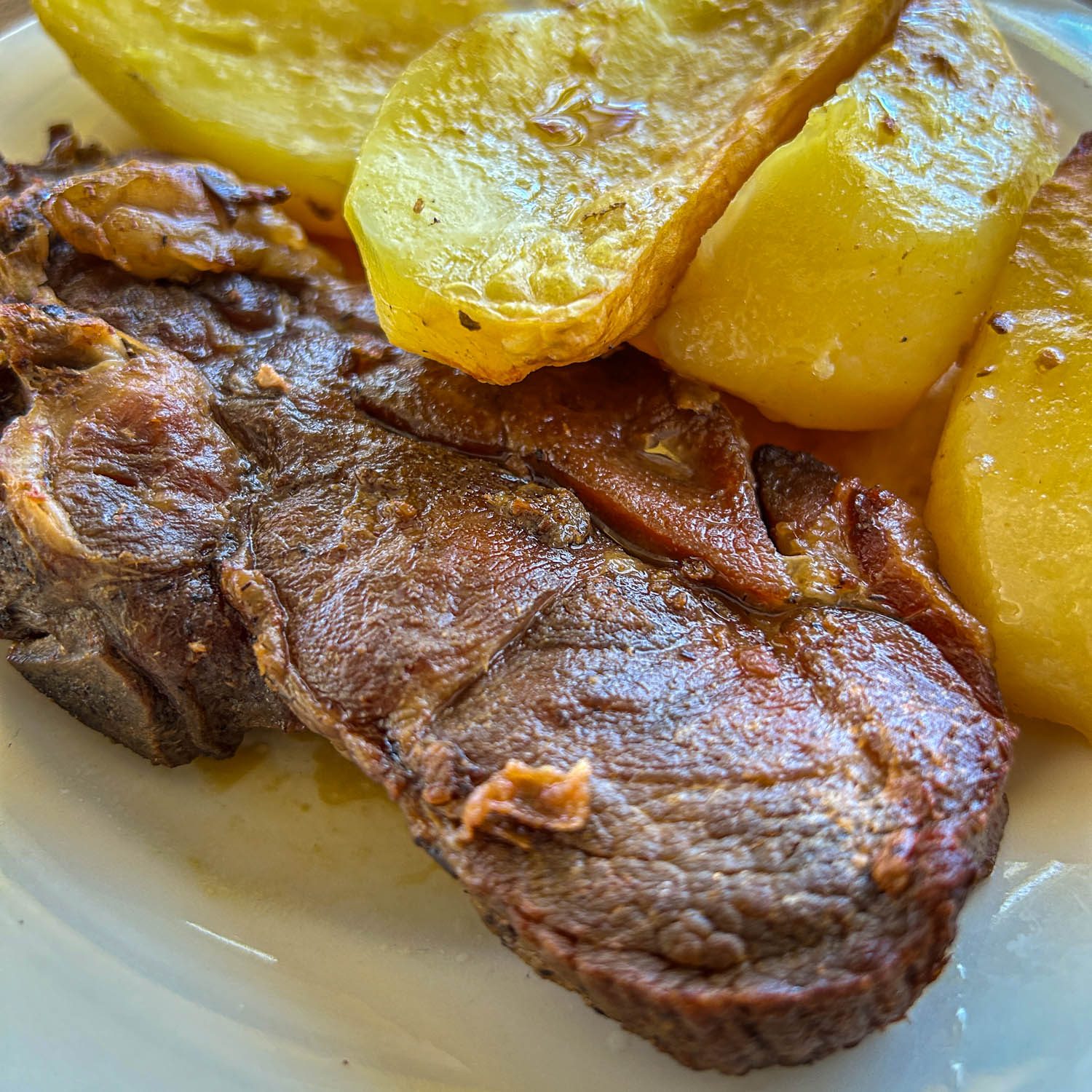
For the most part, I ate the same things I had in Rhodes: moussaka, soutzoukakia, gyros, souvlaki, kleftiko, and pita with tzatziki. The additions to the menu were shrimp saganaki (shrimp in a tomato sauce with feta cheese, usually with some ouzo added to the sauce) and a good roasted pork with potatoes (which I had in a village called Tzermiado, in the middle of nowhere).
But then there was something special I wanted to try, a Cretan traditional dish called antikristo. The word means "opposite" in Greek, and is used because the lamb is cooked around a fire, opposite the flames, usually in a wire cage. Just sprinkle it with salt, let it roast for a few hours, and then serve it with a few roasted potatoes. It's delicious.
Any side trips?
Heraklion, where I stayed, is the capital and the largest town on the island (about 200,000 people). I also visited the second and third largest towns, Chania (110,000 people) and Rethymno (40,000 people).
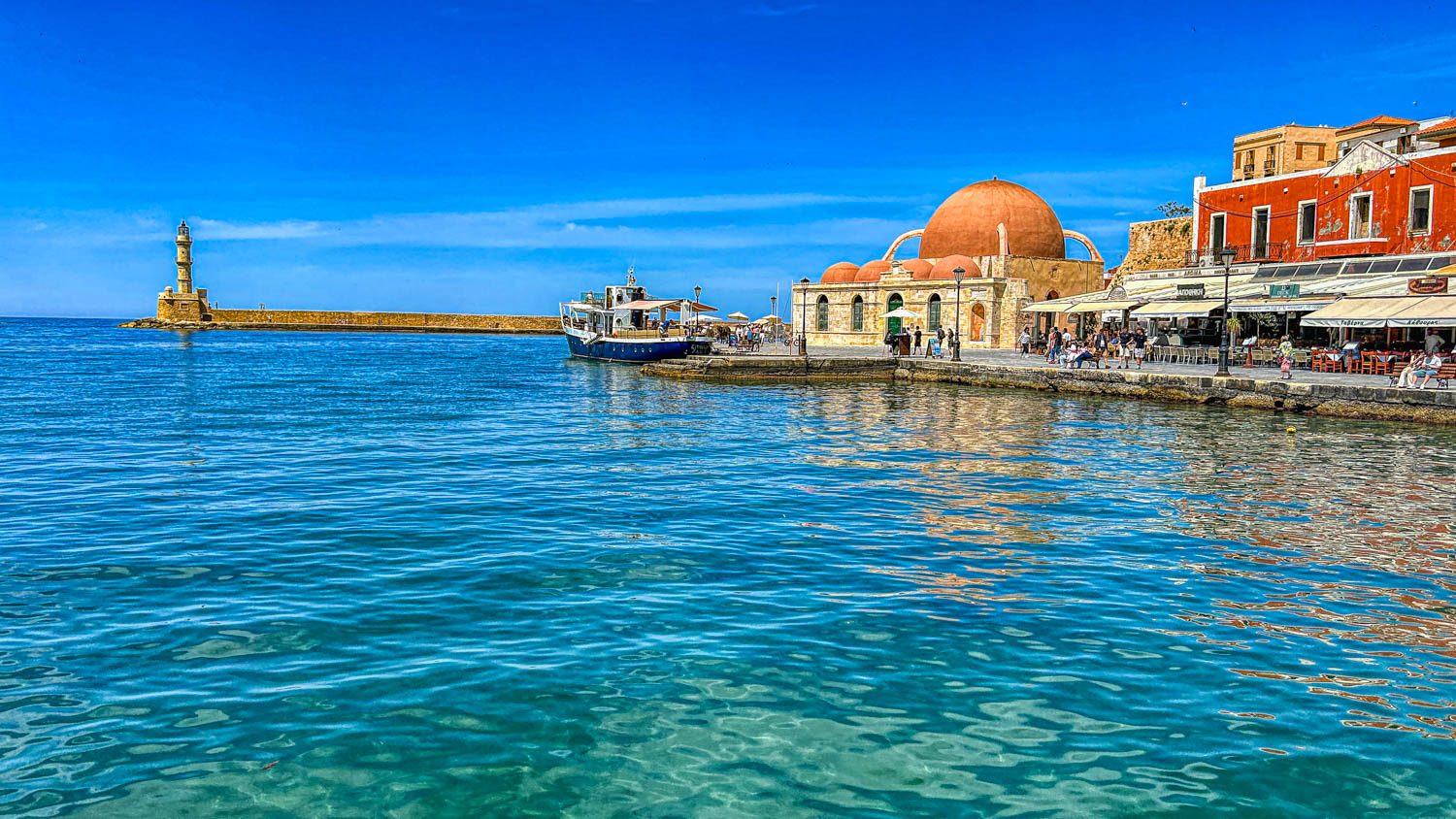
Chania (in Greek, Khaniá), 145 km west of Heraklion, has a pretty harbor area, closed to traffic and full of restaurants. The current lighthouse was built in 1864 in the same place as the medieval Venetian lighthouse.
Chania harborBackstreets of ChaniaI had my lunch (chicken gyros) sitting on this bench
Rethymno, 80 km west of Heraklion, still has a well-preserved Venetian citadel, the Fortezza of Rethymno. The lighthouse is smaller than the one in Chania but older, built in 1830 during the short period Egypt ruled Crete.
Fortezza of RethymnoRethymno LighthouseThe sea in Rethymno
And after Heraklion?
Tomorrow I will move to Venice, and change the kalimera and kalispera to buongiorno and buonasera. But that's a story for another time. Arrivederci!