047April 2026 · Asia

Two weeks in Phnom Penh

Two weeks in Phnom Penh
View from my little balcony: the Tonle Sap in the foreground and the Mekong in the background

Phnom Penh, the capital of Cambodia, is at the confluence of three rivers. The Mekong, which flows down from Laos into Cambodia before going all the way to Vietnam. The Bassac, which splits from the Mekong and flows to the south. And the Tonle Sap, which connects to the Tonle Sap Lake in the north. I rented a small apartment facing the Tonle Sap, which has a curious behavior: depending on the time of year, it can flow towards the Mekong, or it can flow back to the lake.
Phnom Penh means Penh's hill. According to legend, in the 14th century, a wealthy widow named Penh found a tree floating in the river, and inside the tree there were four Buddha statues and one Vishnu statue. She hired the villagers to build an artificial hill (the city is named after this little hill) and a temple atop it to hold those statues. They named the temple Wat Phnom, which means "temple on the hill". The temple was rebuilt many times, and the current version is from 1926. My apartment is about 500 meters from Wat Phnom, and I have visited it a few times.
Inside Wat Phnom
Inside Wat Phnom
Another emblematic attraction in Phnom Penh is the Royal Palace of Cambodia. It's not as large as the Grand Palace in Bangkok (which was built to be almost a city within a city), but it was clearly inspired by the Thai palace, with layers of Khmer and French influences. It’s also not as dense, with fewer buildings, and it has far fewer tourists, so there's a good feeling of spaciousness. The king and his family still live there, but in an area where visitors cannot go.
Royal Palace of Cambodia
The National Museum of Cambodia houses a collection of religious statues. There are many Buddhas, Vishnus, Brahmas, Ganeshas, Shivas, Indras, Garudas, and several others. It also houses the famous K-127, a stone slab with Sanskrit inscriptions that include the earliest known representation of the number zero, dating to 683 CE. I had read about that years ago in the book Finding Zero, by Amir D. Aczel, and it was cool to see it right in front of me.
National Museum of Cambodia
Phnom Penh feels as chaotic as Ho Chi Minh City, but on a much smaller scale (about 3.5 million people instead of 20 million). Cars and street vendors blocking the broken sidewalks, motorbikes zooming around, streets without traffic lights or crosswalks. One difference is that the drivers here actually slow down to let you cross, which is nice. In general, I found people in Cambodia to be more pleasant and more polite than people in Vietnam.
Bananas, bananas, bananas...

The heat


Last time I was in Southeast Asia, in 2024, I left at the beginning of March. This time, I’m staying longer and starting to feel the brutal heat that precedes the monsoon season. And Phnom Penh is landlocked, which makes it worse. The usual daytime temperature has been between 35ºC and 38ºC, but the high humidity makes the heat index easily reach 40ºC. Walking alongside the rivers at least gives you the occasional soothing breeze, but everywhere else there’s an oppressive, humid heat that saps your energy.

Any side trips?


One of the main reasons I came to Cambodia was to visit the Angkor Archaeological Park. When the Khmer Empire (802 to 1431 CE) ruled over most of Southeast Asia, Angkor was its capital. Then it was conquered and abandoned. Today, it has the ruins of over one thousand temples and is a UNESCO World Heritage Site. 

I didn't go on those crazy tourist tours that take you on a car trip lasting six hours, give you three hours to see "all the temples", and then put you back in the car for another six hours on the return trip. Instead, I created my own two-day tour, which is still not enough to see everything but at least allowed me to move at a better pace and visit the most important locations. I took a plane to Siem Reap (forty-five minutes), the closest town to the archeological sites, and a car to the hotel (one hour) that I had booked. From there, I rented a tuk-tuk to take me to eleven temples over two days.

Tuk-tuk adventures
Tuk-tuk adventures
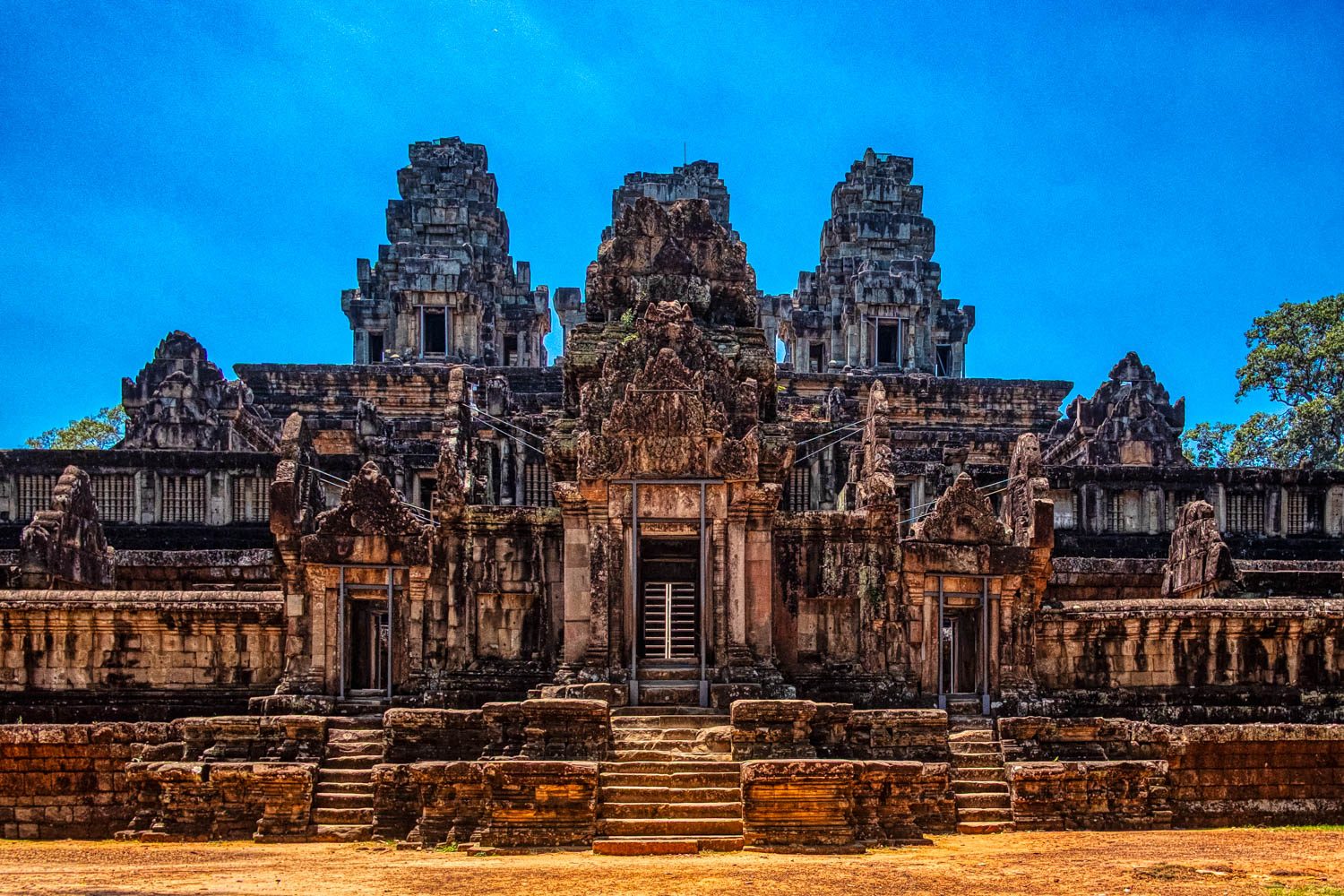
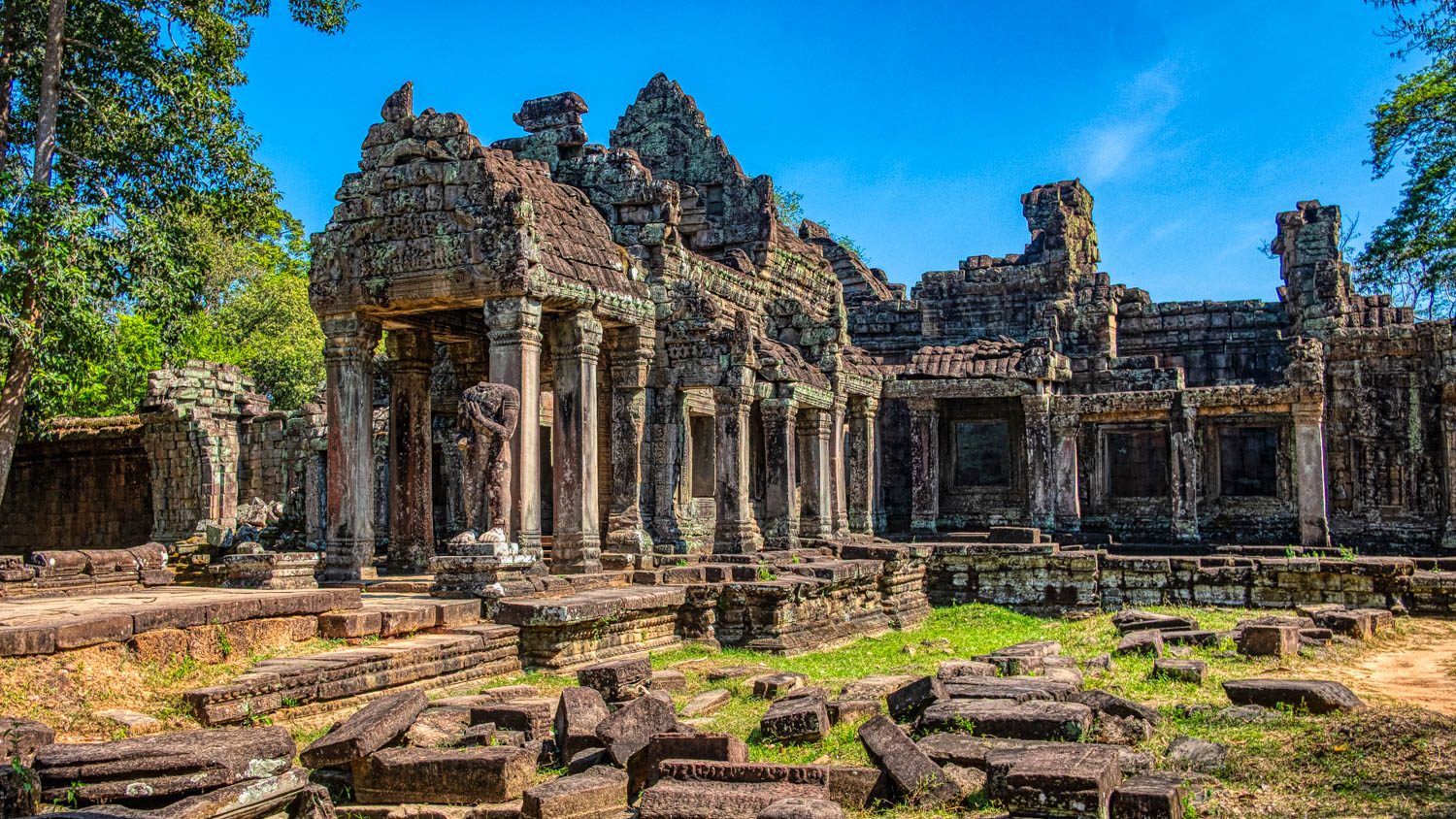
On the first day, I went to Preah Khan (Buddhist temple, 12th century), Neak Pean (Buddhist temple on a circular island, 12th century), Ta Som (Buddhist temple, 12th century), East Mebon (Hindu temple, dedicated to Shiva, 10th century), and Pre Rup (Hindu temple, dedicated to Shiva, 10th century). They were all very interesting, each with unique characteristics, and all left unrestored. After so many centuries, the vegetation has mingled with the architecture in many points, and that combination makes it more captivating.
Preah Khan
Preah Khan
Neak Pean
Neak Pean
Ta Som
Ta Som
Pre Rup
Pre Rup
On the second day, I went to the Bayon (Buddhist temple, 13th century, famous for the enormous smiling faces), the Terrace of the Elephants (platform for royal ceremonies, 12th century), the Baphuon (Buddhist temple, 11th century), Chau Say Tevoda (small Hindu temple, 12th century), Ta Keo (Hindu temple, 11th century), Ta Prohm (Buddhist temple, 12th century, famous for appearing in the movie Lara Croft: Tomb Raider), and, of course, the most notorious of all the temples in the area, Angkor Wat.
Bayon South Gate
Bayon South Gate
Baphuon
Baphuon
Ta Keo
Ta Keo
Ta Prohm
Ta Prohm
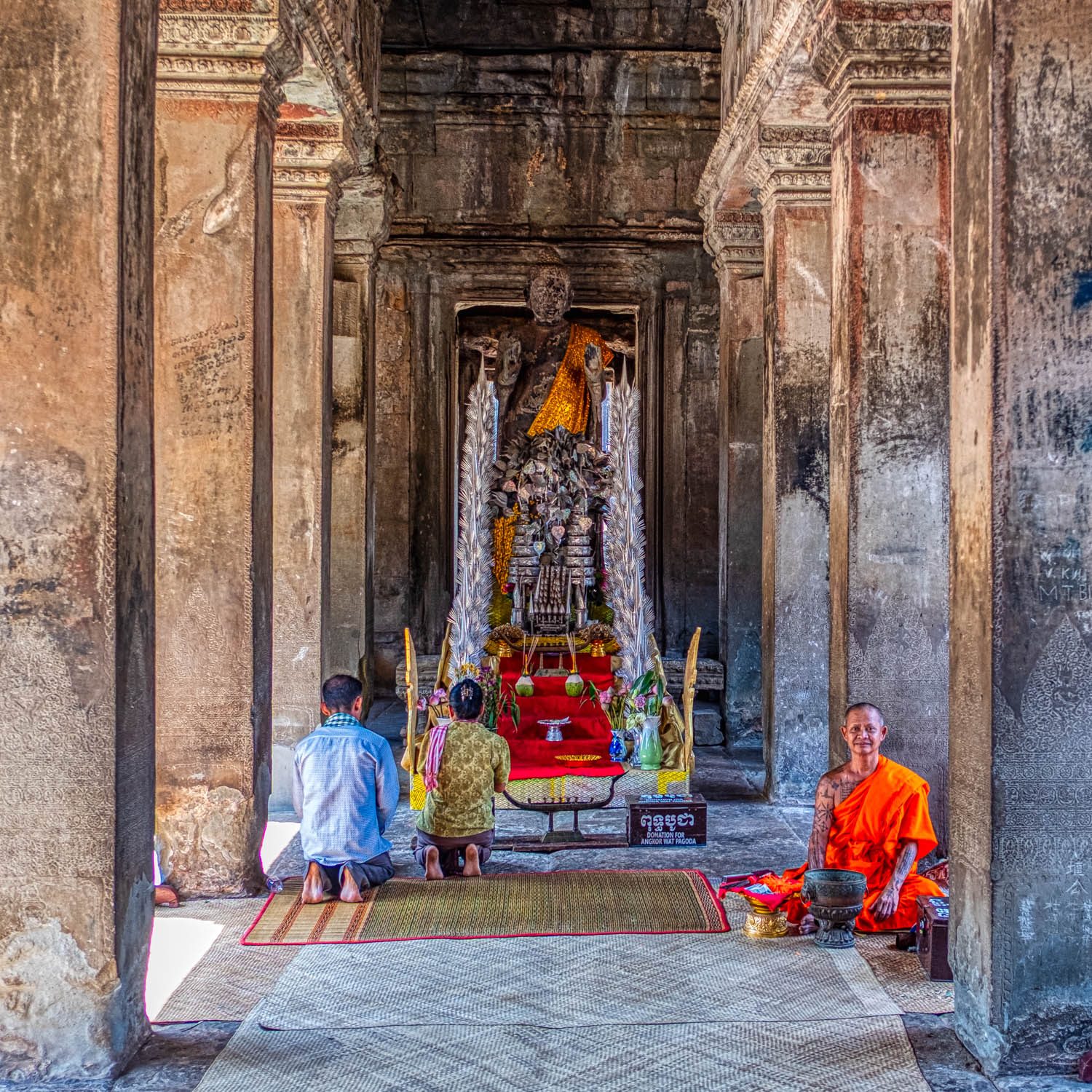
Angkor Wat is the largest religious complex in the world (for reference, it’s over three times the size of the whole Vatican City), built at the beginning of the 12th century as a Hindu temple dedicated to Vishnu and later transformed into a Buddhist temple. Angkor Wat is considered so important in Cambodia that it's depicted on the national flag.

The whole Angkor Archaeological Park is fascinating, not only for the temples but also for the forest and the animals (I saw macaques and water buffaloes). It’s hard to say which temple I liked the most, as each has something different from the others. It was a physically demanding experience. Even with the tuk-tuk taking me from temple to temple, there was much walking involved and many tall, irregular stairs to climb (my smartphone tells me I covered over twenty kilometers in those two incursions), all in the humid Cambodian heat, but it was well worth it.
Inside Angkor Wat
Inside Angkor Wat

And the food?


Amok trei (fish amok) is the national dish of Cambodia. The fish is marinated in green kroeung (a paste made with lemongrass, cinnamon, ginger, and turmeric), coconut milk, and eggs, then put in a container made with banana leaves, and steamed. Pretty tasty.

Other typical Cambodian dishes I ate (always avoiding the spicy ones) were beef lok lak (stir-fried marinated cubes of beef, served with tomatoes and cucumbers, and sometimes a fried egg too) and cha khnhei sach moan (stir-fried ginger chicken, made with fresh ginger, lots of garlic, and oyster sauce). I also ate Chinese food (very common in Phnom Penh) and Japanese food (not so easy to find here).

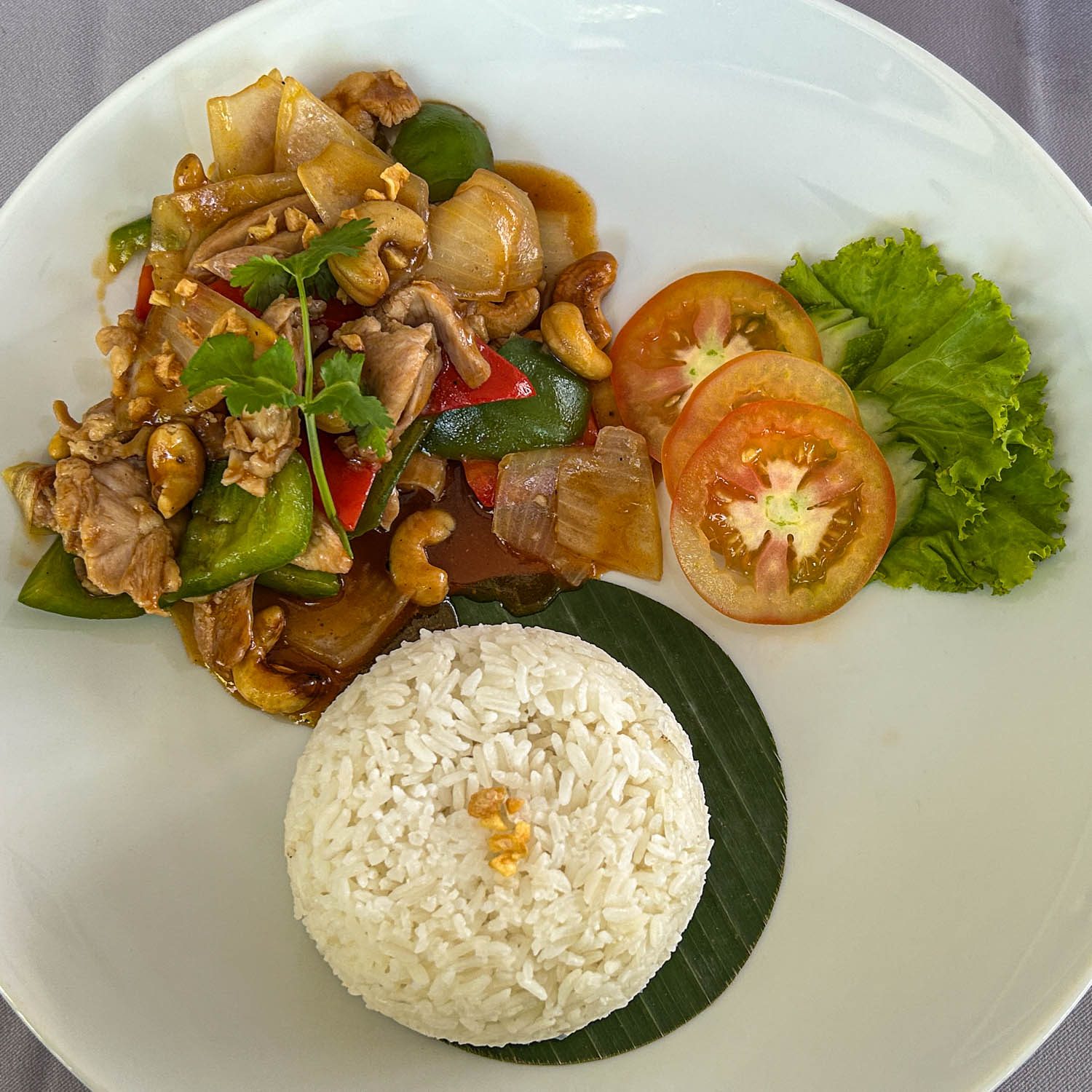
The best dish I had in Cambodia was stir-fried chicken cashew nut (chicken, red bell pepper, green bell pepper, carrot, onion, celery, cashew nut, served with steamed jasmine rice), while I was in Siem Reap. The region produces a lot of cashew nuts, and I even saw, from the road, the plantations full of red fruits.

I think I am quite an adventurous eater, but in Cambodia I found two dishes I had no desire to try. One was crispy deep-fried tarantula legs. The other was a whole frog, grilled on a stick and stuffed with ground pork. I just asked myself why I would eat that, and couldn't find a convincing answer. No, thanks.

Newsletter photograph

And after Phnom Penh?


My next stop is Vientiane, the capital city of Laos. But that’s a story for another time. La gon! (That's how they say "goodbye" in Laos, it means "stay well".)
French colonial architecture in Phnom Penh