While living in Tokyo, I went on a couple of side trips.
Yokohama
I spent a day in Yokohama, the second-largest city in Japan, just less than an hour by train South of Tokyo. It was one of the ports open for commerce with the West when Japan ended its policy of isolationism in 1859. It's also the place where Tom Cruise lands in Japan in The Last Samurai.
My first stop there was the Yokohama Museum of Art. Many famous Western artists on the walls, like Robert Capa, Man Ray, Max Ernst, Joan Miró, Pablo Picasso, Aleksandr Rodchenko, and several others. They also had a few sculptures by Isamu Noguchi (who, despite the name, was an American artist born in Los Angeles). The highlight for me was the large triptych (each painting is about 2.5 meters by 2.25 meters) Salvador Dalí made, inspired by Helena Rubinstein. If that wasn't enough, there was a Magritte in the same room, The Museum of the King.
Then I visited the Nippon Maru, a sail training ship built in 1930 that is now a museum, and climbed to the 69th floor of the Yokohama Landmark Tower to see an amazing view of Yokohama Bay. In theory, you can also see Mount Fuji from there on a clear day, but I got clouds and mist instead.
Sankei-en is a traditional Japanese-style garden built in 1906 to collect historical buildings brought from different parts of Japan. Particularly impressive are the Rinshunkaku, a villa built in 1649 for the son of the first Tokugawa shōgun, and the three-storied pagoda built in 1457 that used to be at the Tōmyō-ji temple in Kyoto.
To close my visit, I went to the Shin-Yokohama Ramen Museum. In the lower floor, they built a full-size replica of parts of Tokyo in 1958, the year instant noodles were invented. You can actually eat ramen at some of the small restaurants in there.
Hakone
I spent three days in Hakone, a small town (about ten thousand people) located in the mountains southwest of Tokyo. I stayed in a ryokan (traditional Japanese inn) with a tatami floor and sliding doors, and I wore a yukata (a summer kimono) and slept on a futon (traditional Japanese bed) on the floor.
Hakone's history as a destination dates back to the Edo period (1603-1868), when it became a key checkpoint on the Tokaido road and a favored hot spring retreat for daimyo (feudal lords) and other wealthy travelers. In the Meiji era (1868-1912), improved transport and the promotion of domestic tourism by the government began to open Hakone to a broader segment of society. The completion of the Hakone Tozan Railway in 1919 further democratized access, turning it into a popular vacation spot for the middle class. After World War II, especially from the 1960s onward, Hakone underwent another transformation, this time into a cultural hub. Museums like the Hakone Open-Air Museum (opened in 1969) and the Pola Museum of Art (opened in 2002) redefined it as a destination for both art lovers and nature enthusiasts.
The Hakone Museum of Art specializes in ceramics, but the best part was the adjoining Japanese garden, the Shinsenkyo. The Hakone Museum of Photography is tiny, but they had good photos of Mount Fuji. The main attraction is, of course, the Hakone Open-Air Museum, a large sculpture garden with outstanding works from all over the world. Rodin, Bourdelle, Maillol, Léger, Hepworth, Milles (this is actually the only place other than Millesgarden in Stockholm where I've seen Carl Milles's large sculptures, and they have two of them), and lots of sculptures by Henry Moore (I counted more than twenty). Amazing. They also have an indoor collection (with Boccioni, Giacometti, Modigliani, Brancusi, and other), a temporary gallery (when I visited they had a funny show by Tetsuya Noguchi, who depicts samurai figures with contemporary objects), and the Pablo Picasso Collection (a pavillion with his paintings, prints, sculptures, ceramics, and tapestries).
The other great museum in Hakone is the Pola Museum of Art, built almost like a contemporary temple to art in the middle of the forest (you take a free van to get to the museum, which is high in the mountains). The exhibition I saw there was A Renewal of Passion: The Impact of Van Gogh. They had some of his paintings, of course, but also works by Cézanne, Monet, Gauguin, Seurat, Matisse, and several Japanese artists who were heavily influenced by Van Gogh.
Hakone has an intricate system of transportation, primarily because it's situated in the mountains and surrounded by extensive forests. The day I went to Lake Ashi, I left the hotel, took a cable car, then took a bus, then took another bus to get there. For the return trip, I took a ship to cross the lake, then took the Hakone Ropeway (an aerial lift system), then took a cable car back to the hotel.
From Lake Ashi, there should be a good view of Mount Fuji. Hokusai and Hiroshige made famous prints from there. But all I got was clouds. Mount Fuji seems to be shy and elusive this time of year.
Mount Fuji
Not deterred by my previous failed attempts to see Mount Fuji, I went on a tour around the Yamanashi Prefecture. Yokohama is to the east of Mount Fuji and Hakone is to the southeast, so this time I tried the northeast area.
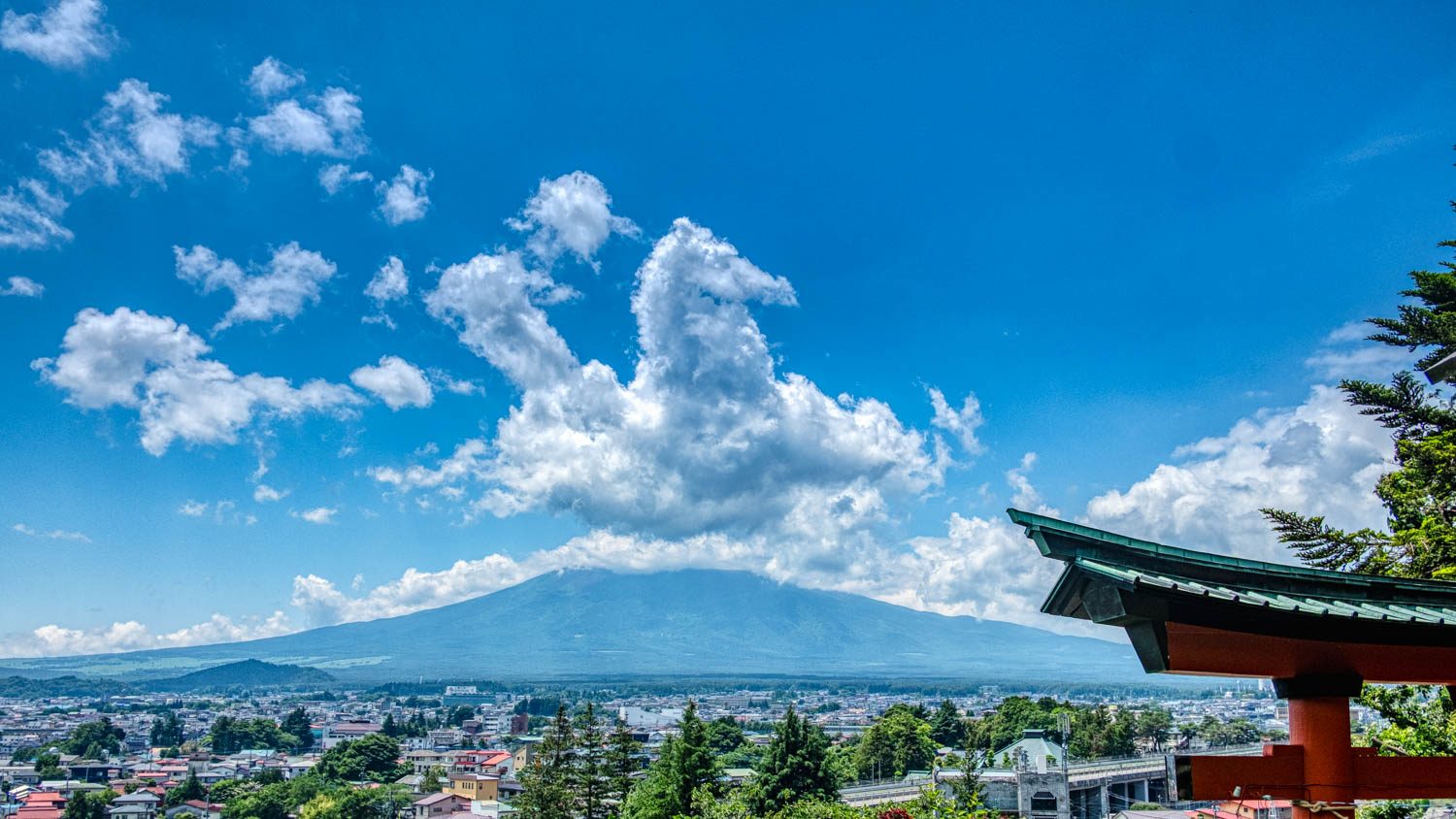
First, I visited Fujiyoshida, home of the Arakurayama Sengen Park and its 398 steps to the pagoda at the top (yes, I climbed every single one of them). That was close enough so that the mountain could not be entirely obscured by the clouds, but the peak was still hidden for most of the time. I only got a brief glimpse of the very top of the mountain from a street corner in Fujiyoshida.
Then I went to Fujikawaguchiko, home of the Oishi Park. From there, I could see Mount Fuji on the other side of Lake Kawaguchi. Even though the peak was still shrouded in clouds, the view was still breathtaking.
Lastly, I went to Oshino Hakkai (Eight Seas in Oshino), which has eight ponds of water that come from Mount Fuji. It's mostly a tourist trap full of little shops selling trinkets. There is no view of Mount Fuji from there, but at least I drank the refreshing momo matcha (matcha tea sweetened with peach, served cold).
After Tokyo
I left Tokyo wishing I could stay for another year. But before leaving Japan, there is more to see. One week in Osaka, another week in Kyoto, and another one in Nagoya. I will tell about that in the next part of the thrilling serial Three Months in Japan.